India Art Fair remains the country’s biggest stage for contemporary art. Which is why it deserves sharper scrutiny.
This year felt like a mixed bag.
The sculptural line up at the entrance should have set the tone. It did, though not in the way one would hope. The works lacked rigour. Monumental scale without conceptual weight rarely convinces. An art fair entrance is a statement. It says this is where we are headed. That statement felt hesitant.
Inside the booths, a pattern emerged. Many galleries showed works that had already been seen in Mumbai or very similar selections. Safe choices. Proven names. Familiar formats. I understand why. A fair is expensive. Booth rentals, shipping, insurance, staff, hospitality. For smaller and mid sized galleries, one wrong gamble can hurt. Playing safe becomes survival.
Yet when everyone plays safe, the fair becomes predictable.
International galleries did little to shift the mood. A few stood out, though many brought works that felt recycled from other circuits. If India is to be treated as a serious market, it deserves curated risk. It deserves context. It deserves ambition.
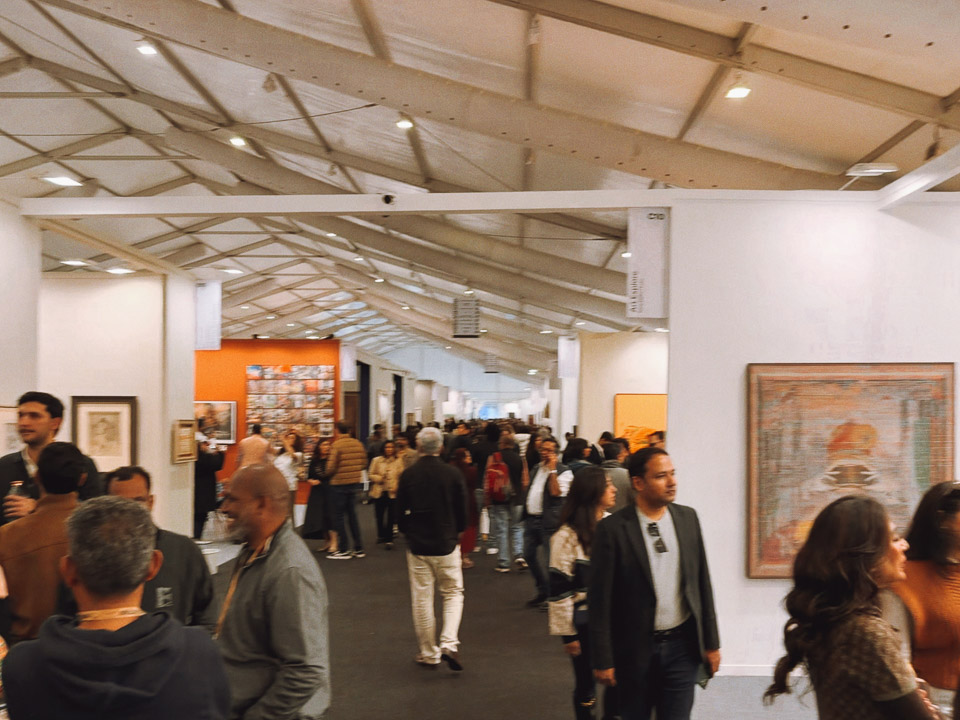
There is another issue that needs to be addressed directly. A VIP day has to be exactly that. It cannot turn into a general admission preview. The first hours of a fair are critical. This is when serious buyers view calmly, ask questions, take decisions. This year, hordes of people flooded the space. Galleries were forced to manage crowds instead of engaging collectors. Precious time was lost. Energy was diffused. A VIP preview must be controlled and curated. Access must mean access. If everything is VIP, nothing is.
The responsibility does not lie with galleries alone.
Buyers must take a hard look at themselves. The same eight to twelve artists circulate through most serious collections. Their prices rise. Their visibility compounds. Meanwhile, younger or less visible artists struggle for oxygen. If collectors truly believe in building a cultural ecosystem, they must widen their lens. A mature market supports depth. It backs conviction. It does not chase comfort.
The fair organisers also need to rethink structure. Design has grown louder within the fair’s framework. There is room for design. There is value in it. Yet art should not feel diluted within its own flagship platform. The fair must clarify its identity. Is it a design and lifestyle destination, or is it the country’s most important contemporary art platform. It cannot drift.
Masters and moderns deserve a distinct space. When historically significant artists are placed beside emerging contemporary practices without curatorial framing, both suffer. Separation can create clarity. It can elevate dialogue rather than blur it.
Viability is the real test. If smaller and medium galleries cannot sustain participation, the fair risks becoming top heavy. A healthy fair supports its mid tier. It creates incentives. It creates breathing room. Without that, diversity shrinks.
The wider landscape is shifting. Frieze and Art Basel have already expanded into the Middle East. There is talk of further expansion. If global giants enter India, the benchmark will change overnight. Production values, programming, collector engagement, institutional presence. Everything will be measured differently.
This is not a call for imitation. India does not need a copy of anyone. It needs confidence. It needs sharper curation. It needs risk shared across galleries, buyers, and organisers.
An art fair is a mirror. It reflects the market’s courage, or its caution.
Right now, the reflection suggests we are capable of more.