Tap aur Tapish was a monumental exhibition. Monumental in scale, ambition, risk and, above all, in ceramic.
I have known Vipul Kumar for around a decade. Over those years there have been exhibitions, studio visits, long conversations, disagreements, difficult decisions and many cups of tea. I have watched his practice evolve closely. So, for me, Tap aur Tapish was not simply another exhibition. It felt like the culmination of a long journey.
Vipul had wanted to make a show of this scale for a long time.
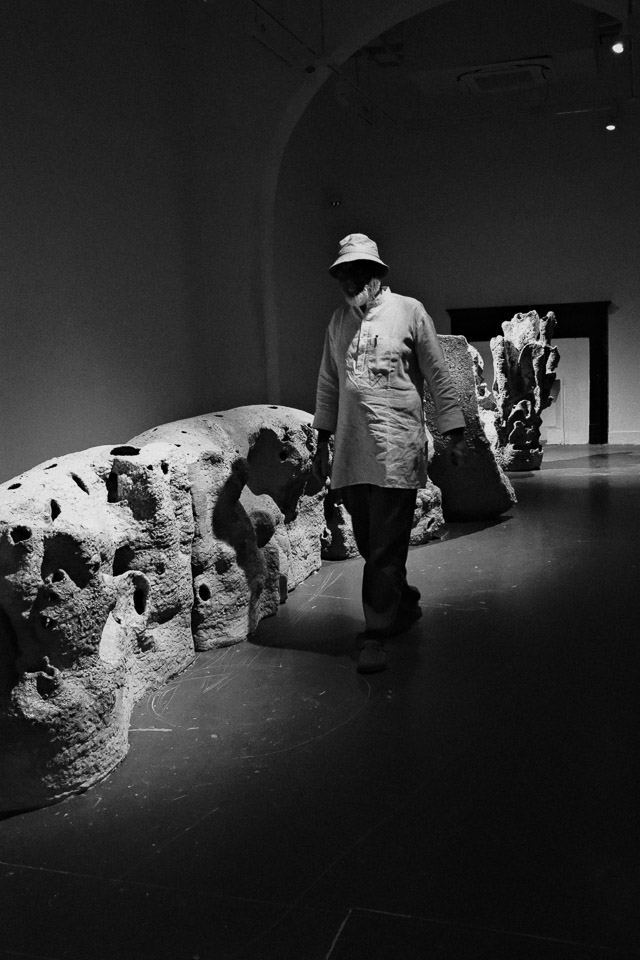
He has devoted his life to sculpture. He trained as a stone carver before clay became his primary material, and I think stone has never really left him. He approaches clay with the patience of someone who understands resistance. There is a strength in his work that comes from that relationship with material, yet there is also a sensitivity that belongs entirely to ceramics. I wrote about this in The Long Way to Clay, and seeing the work occupy Bikaner House made me understand it even more clearly.
What made Tap aur Tapish remarkable was not simply its scale.
There are not many ceramic artists in India working at this scale, and fewer still whose work has such a distinctive language. Vipul’s abstract and semi abstract forms move between the mythical and the environmental. They suggest landscape, memory, geological formations, fragments of architecture and forms that seem to sit somewhere between the imagined and the remembered.
He once told me, “The environment is what I am interested in.” I have thought about that sentence often. He was not talking about environmental activism. He was talking about a relationship with the world around him. Clay itself comes from the earth. Water, air and fire become part of its transformation. His work seems to understand this instinctively.
The material language is equally important. The glaze, texture and colour are not decorative additions. They are part of the sculpture’s identity. His wood firing brings another element into the process, allowing fire and material to participate in what finally emerges from the kiln. The technique is present, but it never feels like a demonstration of technique.
This is where I think Vipul has developed something genuinely his own.
Being closely involved with the exhibition, I was also privy to the enormous challenges behind it.
Around 45 works were displayed, nearly 20 of them measuring five feet or more. One sculpture stood at an extraordinary 11.5 feet. Some of the works weighed close to half a tonne.
Getting these sculptures from Vipul’s studio in Rajasthan to Bikaner House was a logistical nightmare. These are not objects you simply pack and transport. Every movement has consequences. Packing, loading, transport, unloading, positioning and installation all demanded enormous planning and care.
For the gallery, taking the entire CCA building was itself a major risk. There was the financial commitment, the logistics and the sheer challenge of mounting an exhibition of this scale. We were asking a great deal from everyone involved.
There was always the possibility that the scale could overwhelm the work.
It did not.
A large part of that was Anita Dube.
She was phenomenal in the way she handled the scale and selection. She understood that the exhibition could not simply be a collection of large ceramic sculptures. The works needed space, pauses and a rhythm. The larger pieces held their ground, while the smaller and more delicate works gave the eye somewhere else to go.
Her curatorial decisions allowed the work to breathe.
For Vipul, the process was emotionally draining. I saw some of that first hand. There was the physical exhaustion, the pressure of making works at this scale and the knowledge that the exhibition represented something he had wanted to achieve for years.
Anyone who knows Vipul knows that he will return to the studio. That has always been his answer. He works, he questions, he makes, he fires and he starts again. The studio has always been the centre of his life. Tap aur Tapish demanded that commitment on a completely different scale.
And then the exhibition opened.
The attention Vipul received from his peers, collectors, museums and the wider art community made much of the exhaustion worthwhile. People spent time with the work. Senior collectors engaged seriously with it. Artists responded to what he had attempted. Museums and institutions took notice.
For an artist who has spent so many years quietly developing his practice, that recognition meant a great deal.
For me, that was one of the most satisfying aspects of the exhibition. I have seen Vipul work for years without any desire to make himself appear more complicated than he is. He has always been more interested in the work than in constructing a story around himself. That honesty is part of what makes his practice compelling.
For the gallery, too, there was a sense that the risk had been worth taking.
We could have made a smaller exhibition. We could have stayed within familiar parameters. Instead, we decided to give Vipul the space to attempt what he had wanted to do.
I am glad we did.
Tap aur Tapish was ambitious and it was risky. But its achievement was never simply that Vipul made very large ceramic sculptures. It was the coming together of scale, technique, wood firing, glaze, texture, colour and a personal vocabulary that moves between abstraction, mythology and the environment.
When you stood inside Bikaner House, surrounded by nearly 45 ceramic sculptures, some reaching over five feet and one rising to 11.5 feet, you could feel the scale of the commitment behind it.
The show ended yesterday. As I write this, I spoke to Vipul. He was already on his way back to his studio in Rajasthan.
There was something very familiar about that.
For all the attention, the exhaustion, the scale and the achievement of Tap aur Tapish, Vipul is already thinking about the next work. The exhibition is over, but the practice continues.
Perhaps that is the best way to understand Vipul.
He goes back to the studio.
He starts working again.